
There are all sorts of bizarre little bits in medical history, such as treatments that would seem almost unbelievable today. Few stories get repeated as often as the one about vibrators and "hysteria." It's been retold in books, documentaries, and even a Hollywood film, usually presented as a well-documented fact. No, there's no reliable historical evidence that doctors routinely used vibrators to treat "hysteria" in women by inducing orgasm.
So two historians went back to the sources to check this out and found something odd: The evidence just doesn't exist. Where did this story originate, and what was actually being done by doctors to cure hysteria? Here is the true story behind the myth.
What Was Female Hysteria?
For centuries, women's hysteria was recognised as a medical problem, and its medical history goes back to ancient Greek medicine. A few key facts:
- Symptoms attributed to it were broad and vague, covering everything from anxiety to fatigue.
- It remained part of mainstream psychiatric classification surprisingly late.
- The condition was still listed in the American Psychiatric Association's DSM-II in 1968.
- It wasn't removed from psychiatric classification until the DSM-III in 1980.
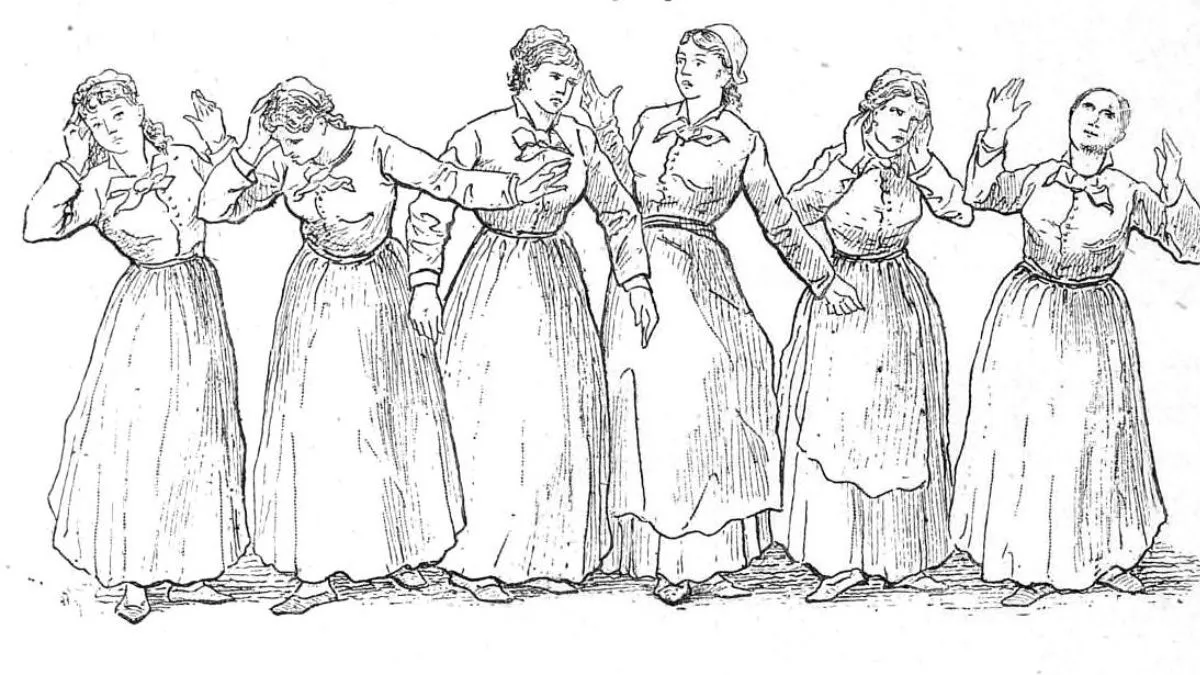 female hysteria
Key Terminology Glossary
Term |
Meaning |
Female hysteria |
A now-discredited medical diagnosis, used for centuries to describe a wide range of symptoms in women, including anxiety, fainting, irritability, and nervousness. |
Hysterical paroxysm |
The term some historical writers used to describe the endpoint of certain treatments; often interpreted in modern retellings as referring to orgasm. |
Pelvic massage |
A supposed historical treatment involving manual stimulation, central to the disputed vibrator-hysteria story. |
Electrotherapy |
A genuine, widely used late 19th and early 20th-century medical practice involving electrical and mechanical devices, including vibrators, for various ailments. |
The Old Cure for Hysteria: What Doctors Actually Believed
For years, the widely accepted story of the old cure for hysteria came from a single, highly influential source: historian Rachel Maines' 1999 book, The Technology of Orgasm. Maines argued that Victorian physicians routinely performed "pelvic massage" to induce a "hysterical paroxysm" in hysterical female patients, and that vibrators were later adopted simply to make this labour-intensive treatment more efficient.
ALSO READ- Why Was Depression Once Blamed on Black Bile? The 2,500-Year-Old Theory Explained
The Invention of the Vibrator and Female Hysteria: Where the Myth Began
Maines' book became enormously influential. It inspired a Broadway play and the 2011 film Hysteria, and her claims were repeated across dozens of academic and popular sources.

The core idea: doctors didn't see the practice as sexual because it didn't involve penetration, so vibrators became a discreet, efficient medical tool.
Debunking Myths About Female Hysteria and Vibrators
In 2018, historians Hallie Lieberman and Eric Schatzberg published a paper in the Journal of Positive Sexuality examining every source Maines cited to support her claims. Their conclusion was blunt:
- "We could find no evidence that physicians ever used electromechanical vibrators to induce orgasms in female patients as a medical treatment."
- "Manual massage of female genitals was never a routine medical treatment for hysteria."
 female hysteria (1)
Many historical vibrator attachments were, in fact, designed for penetrative use, undermining Maines' claim that doctors avoided penetration to keep the practice non-sexual.
The Role of Vibrators in Early Gynaecology
So what were vibrators actually used for? Genuinely, they were part of the electrotherapy boom, marketed for headaches, muscle pain, and general "nerve" complaints, alongside a huge range of other conditions, in both men and women.
They were sold openly to the public, including in mainstream household catalogues, which itself argues against the idea that their use was secretly sexual, since such marketing would have been scandalous if true.
Evolution of Vibrators From Medical Tool to Pleasure Device
While vibrators were later connected to sexual pleasure, it was a slow process that took place throughout the 20th century and not as an ongoing clandestine medical practice. In a 2020 op-ed for The New York Times, Lieberman noted that the myth's popularity says as much about modern assumptions as it does about actual Victorian medicine.
ALSO READ- Did Doctors Actually Prescribe Cocaine? Uncovering Medicine's Most Surprising Secret
Conclusion
The vibrator-hysteria story is a compelling one, which is likely part of why it spread so widely. But as one of the historical medical devices for women's health most misunderstood today, the real story is less about secret Victorian pleasure and more about how easily an unverified idea can become accepted fact.
FAQ
1. Why was the vibrator-hysteria myth so prevalent if it was not true?
The narrative was engaging for its ability to reflect the modern views on Victorian sexual repression and medical paternalism. It seemed plausible without any evidence, and it was seldom subjected to any factual verification because it was passed down from one source to another.2. Is female hysteria recognised as a medical condition today?
No. It was formally removed from psychiatric classification with the DSM-III in 1980, and its symptoms are now understood through more specific, modern diagnoses rather than a single catch-all condition.
All possible measures have been taken to ensure accuracy, reliability, timeliness and authenticity of the information; however Onlymyhealth.com does not take any liability for the same. Using any information provided by the website is solely at the viewers’ discretion. In case of any medical exigencies/ persistent health issues, we advise you to seek a qualified medical practitioner before putting to use any advice/tips given by our team or any third party in form of answers/comments on the above mentioned website.
How we keep this article up to date:
We work with experts and keep a close eye on the latest in health and wellness. Whenever there is a new research or helpful information, we update our articles with accurate and useful advice.
-
Current Version
Sep 08, 2026 13:49 IST
Modified By : Vivek Kumar Sep 08, 2026 13:49 IST
Published By : Vivek Kumar