
Testing for pregnancy in today’s world is easy and convenient. All you need is an at-home pregnancy kit, which is readily available at stores. This may not always give accurate results, but it has pretty good success rates. Then you have urine, blood and other types of tests which can give you a more confirmed answer. But have you ever wondered how people test for pregnancy before these modern methods came into being?
You will be surprised to learn that in ancient times, people used bizarre methods such as urinating on seeds or inserting onions inside vagina, to check if a woman is expecting. To know more about the surprising history and evolution of pregnancy tests, read on.
How Pregnancy Tests Were Performed in the Ancient Times
A 2023 study, published in the Antibodies journal, explored the fascinating history of pregnancy tests. It highlighted how long before modern science, ancient civilizations depended on some bizarre methods to test for pregnancy. Let us take a look at some of them:
Urinating on Seeds Test
The earliest known pregnancy test was in ancient Egypt, about 4,000 years ago. It involved a woman urinating on bags of wheat and barley seeds for several days. If the seeds sprouted, then that woman was announced as pregnant. The Egyptians even believed that the type of grain that grew first can even predict the baby's gender.
Onion Smell Test
Thereafter, medical figures such as Hippocrates and Galen suggested an unusual ‘onion test’ to determine pregnancy. Here, expecting women had to insert an onion into their vagina and keep it overnight. Then they had to see if the smell traveled through her body. If her breath smelled like onions the next morning, then the doctors came to the conclusion that she was not pregnant. It used the logic that an empty womb allowed the scent to reach her mouth.
 history of pregnancy test 2
Urine Inspection
By the Middle Ages, people attempted to detect pregnancy simply by inspecting the colour, clarity, and foaminess of a woman's urine. Other bizarre historical methods included mixing a woman's urine with wine to look for a reaction, or keeping a metal needle in the urine to see if it rusted. Some ancient tests even involved dipping a ribbon in urine and burning it. If the resulting odour made the woman instantly nauseous, then she was deemed pregnant.
The study noted that while these ancient techniques may sound absurd today, they highlight how humanity's long-standing search to detect pregnancy eventually created the way for modern medical science.
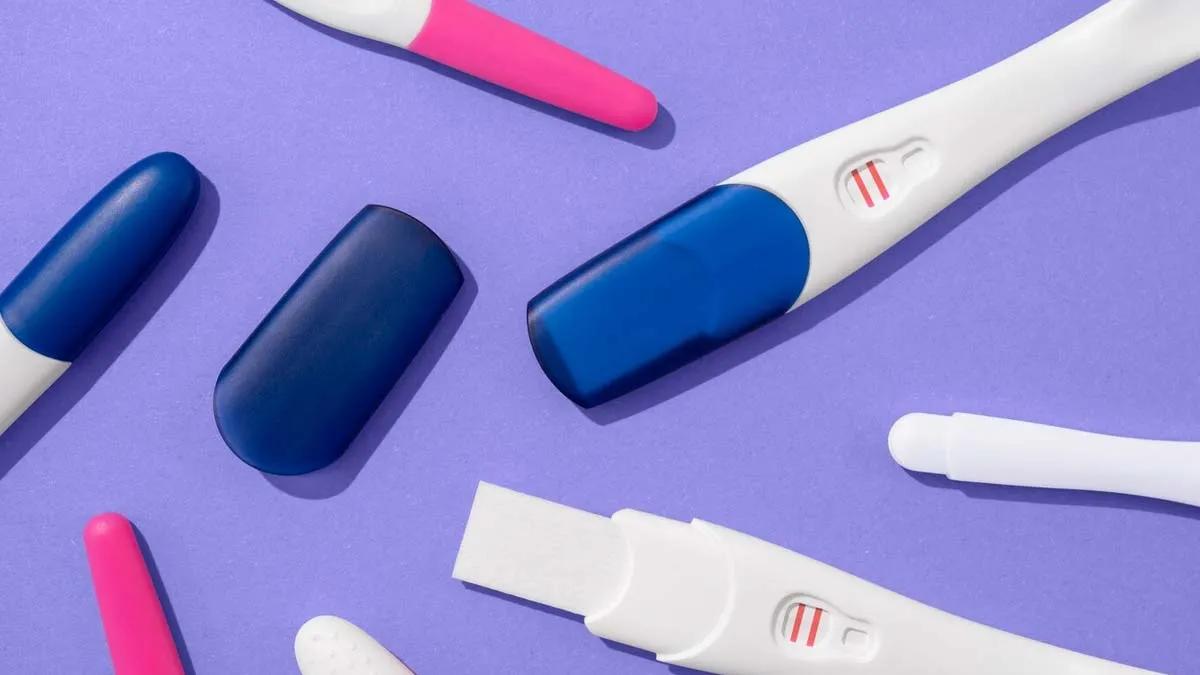 history of pregnancy test 3
How Modern-day Pregnancy Tests Came Into Being
The National Institutes of Health (NIH) shared a report on how modern pregnancy tests owe their existence to groundbreaking hormone research conducted by scientists in the early 1970s.
- The report mentioned that American medical researchers, Judith Vaitukaitis and Glenn Braunstein, started studying reproductive endocrinology. It was a relatively new field at the time. They focused heavily on Human Chorionic Gonadotropin (hCG). This is a specific hormone secreted by the human body during pregnancy or in the presence of certain cancers.
- The main goal of the researchers initially was to find a trusted way to measure hCG to track cancerous tumours during treatment. Before their research, existing tests could measure hCG but could not distinguish it from another similar hormone called luteinizing hormone (LH). This often led to inaccurate results.
- In 1972, Vaitukaitis successfully generated an antibody. It finally allowed scientists to isolate and measure hCG accurately. This specific antibody became the crucial baseline for future radioimmunoassays. This created the way for precise pregnancy and cancer detection.
- Consequently, by 1978, this revolutionary scientific breakthrough arrived on drugstore shelves as the very first home pregnancy tests.
ALSO READ- Can You Take Painkillers During Pregnancy? What's Safe and Why Trimester Matters
Conclusion
From the unusual seed and onion methods performed by the ancient Egyptians to the precise hormonal science of the 1970s, the evolution of pregnancy testing is indeed an interesting one. It is a remarkable journey of medical advancement. The groundbreaking discovery of hCG antibodies by dedicated researchers not only transformed cancer tracking, but it also revolutionised women's healthcare by providing privacy and certainty. Today, a simple and reliable at-home test kit is a fascinating reminder of just how far medical diagnostics have come.
FAQ
What is the oldest pregnancy test?
One of the earliest written records of a pregnancy test can be found in an ancient Egyptian document, which described a test in which a woman urinated on wheat and barley seeds over the course of several days.What was the rabbit test for pregnancy?
The rabbit test, developed in the 1920s and 1930s, involved injecting a woman's urine into a female rabbit and then dissecting the animal 48 hours later to see if the hormone hCG in the urine had caused its ovaries to swell and change.
All possible measures have been taken to ensure accuracy, reliability, timeliness and authenticity of the information; however Onlymyhealth.com does not take any liability for the same. Using any information provided by the website is solely at the viewers’ discretion. In case of any medical exigencies/ persistent health issues, we advise you to seek a qualified medical practitioner before putting to use any advice/tips given by our team or any third party in form of answers/comments on the above mentioned website.
How we keep this article up to date:
We work with experts and keep a close eye on the latest in health and wellness. Whenever there is a new research or helpful information, we update our articles with accurate and useful advice.
-
Current Version
Aug 07, 2026 19:03 IST
Published By : Shruti Das