
If you have already had H1N1 influenza, you may assume you are protected from catching it again. Similarly, if you receive an annual flu vaccine, you may wonder whether that means H1N1 is no longer a concern.
Unfortunately, neither offers permanent protection.
“Since the 2009 pandemic, H1N1 influenza has become a recurring seasonal presence rather than a one-off event,” says Dr Tushar Tayal, Associate Director - Internal Medicine, CK Birla Hospital, Gurugram. He explains that previous infection or vaccination can provide protection, but this protection is neither lifelong nor absolute.
Understanding why is important because assuming you are permanently immune can lead to unnecessary complacency, while fearing that every previous infection has left you completely unprotected can cause needless anxiety.
Can You Really Get Influenza Twice?
Yes, reinfection is possible.
H1N1 is a subtype of influenza A. The strain that caused the 2009 pandemic, known as A(H1N1)pdm09, has continued to circulate as a seasonal influenza virus.
When you catch influenza, your immune system produces antibodies and other immune responses directed against the virus. These defences can provide protection against the same or closely related viruses.
However, influenza viruses are constantly changing.
Small genetic changes can accumulate in influenza viruses through a process known as antigenic drift. As the virus changes, antibodies produced after an earlier infection may become less effective against a newer version.
This means someone who had H1N1 in one flu season may still become infected with a different or sufficiently changed H1N1 virus later.
Why Immunity After Infection Does Not Last Forever?
The immune response following an infection can be strong, but it does not mean the body will recognise every future version of the virus equally well.
Dr Tayal explains that protection following infection is generally strain-specific. Previous infection can provide residual protection, particularly against severe disease, but the strength and duration of that protection vary from person to person.
Several factors can influence immunity, including the individual's immune response, age and how closely related a later circulating strain is to the virus that caused the earlier infection.
This is one reason influenza is different from infections such as measles, where immunity after infection is generally much longer lasting.
So, recovering from H1N1 should not be viewed as a lifetime pass against future influenza.
Also Read: Nearly 600% H1N1 Surge in Delhi: Why Swine Flu Cases in Delhi Are Rising Even During the Monsoon
What If You Had H1N1 Recently?
A recent infection may provide some protection against the same or a closely related strain for a period of time. But that does not mean you are protected against all influenza viruses circulating during the season.
It is also possible to mistake one respiratory infection for another. Influenza, COVID-19 and several other viral infections can cause overlapping symptoms such as fever, cough, sore throat, tiredness and body aches.
Therefore, someone who believes they have had influenza previously may not necessarily have had laboratory-confirmed H1N1.
The practical message is simple: a previous flu infection should not change the way you respond to new flu-like symptoms.
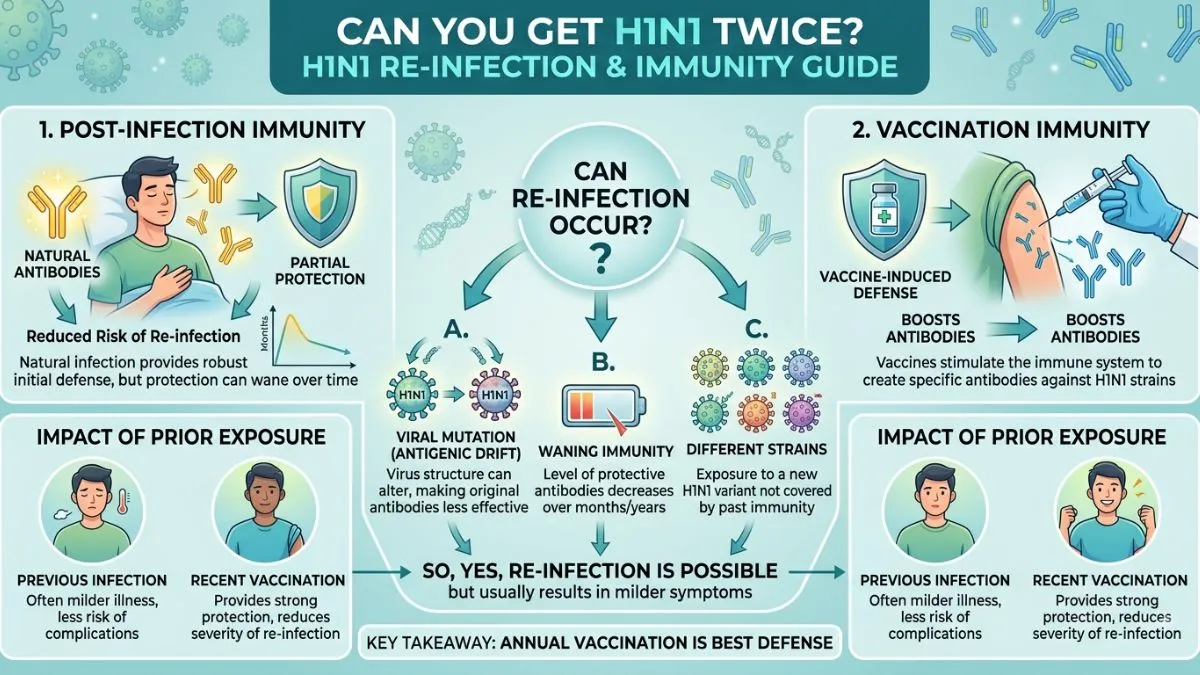 Can You Really Get Influenza Twice
Can You Get H1N1 After Vaccination?
Yes, confirms a PubMed study.
The flu vaccine does not provide 100 per cent protection against infection. Its effectiveness can vary from season to season depending on factors such as the match between vaccine strains and viruses circulating in the community, as well as the person's age and immune response.
However, according to the Centers for Disease Control and Prevention (CDC), vaccination remains an important tool because it can reduce the risk of influenza illness and, importantly, help reduce the risk of severe disease, complications and hospitalisation.
Annual vaccination is recommended because influenza viruses continue to evolve and immunity can decline over time.
Why Do Flu Vaccines Need Updating?
The influenza virus does not remain genetically identical from one year to the next.
Scientists and public health authorities monitor influenza viruses circulating around the world and use this information to update vaccines so they target viruses expected to circulate in the coming season.
This means your flu vaccination from a previous year should not be considered equivalent to this year's vaccination. The principle is similar to updating protection as the virus changes.
Does Previous H1N1 Infection Mean You Can Skip The Vaccine?
No.
One of the most common misconceptions is that natural infection makes vaccination unnecessary.
Dr Tayal points out that vaccination after a previous infection can help reinforce and broaden the immune response, particularly as newer influenza strains emerge.
Having had H1N1 in the past therefore does not automatically mean you should avoid seasonal influenza vaccination.
The appropriate timing and need for vaccination can depend on individual circumstances, so people should follow recommendations from their healthcare provider and local health authorities.
Also Read: Considering Flu Vaccines In Winter?
Can The Flu Vaccine Give You Influenza?
No.
This is another common myth busted by the World Health Organization.
Modern seasonal influenza vaccines are designed to stimulate the immune system without causing influenza infection. Depending on the vaccine, they contain inactivated virus components or other non-infectious material; some influenza vaccines use live attenuated virus, but these are specifically designed not to cause typical influenza illness in healthy people.
Therefore, developing a fever or feeling unwell after vaccination does not mean you have caught H1N1 from the vaccine.
Some people can experience temporary side effects such as soreness at the injection site, mild fever or tiredness. These are generally signs of the immune system responding to vaccination rather than influenza infection.
What Happens If You Catch H1N1 Again?
For many otherwise healthy people, influenza causes symptoms such as fever, cough, sore throat, headache, muscle aches, tiredness and sometimes a runny or blocked nose.
A previous infection or vaccination may mean the immune system can respond more effectively, potentially reducing the severity of illness. But protection varies, and reinfection can still make someone significantly unwell.
Some people are at greater risk of complications, including older adults, pregnant women, young children and people with certain underlying medical conditions.
Complications can include pneumonia and worsening of existing conditions such as asthma or heart disease.
What Should You Do If Flu Symptoms Return?
Do not assume that because you had H1N1 before, a new episode of fever and cough cannot be influenza.
If symptoms are significant, persistent, or worsening, speak to a doctor. Testing may be recommended in some circumstances, particularly when knowing the specific infection would affect treatment or infection-control decisions.
Antiviral medicines can be useful for some people with influenza, particularly those at higher risk of complications or those who are seriously ill. They work best when started early, so people at higher risk should seek medical advice promptly rather than waiting for symptoms to become severe.
When To See a Doctor
Seek urgent medical attention for warning signs such as difficulty breathing, persistent chest pain, confusion, severe weakness, dehydration, or symptoms that improve and then suddenly become worse.
Tips To Reduce The Risk of Reinfection
Whether or not you have had H1N1 before, sensible precautions remain useful.
- Get the seasonal influenza vaccine when recommended.
- Wash your hands regularly.
- Avoid close contact with people who are unwell when possible.
- Cover your mouth and nose when coughing or sneezing.
- Stay home when you are sick and avoid spreading the infection to others.
- Seek medical advice early if you develop significant symptoms, particularly if you are in a high-risk group.
Final Word
Having H1N1 once does not mean you can never get it again. Being vaccinated does not guarantee that you will never become infected either. Influenza's ability to evolve means immunity can become less effective against newer strains, while protection from vaccination can also decline with time. But this does not mean previous infection or vaccination is useless. Previous exposure can provide some protection, and vaccination remains one of the most effective ways to reduce the risk of serious influenza illness.
FAQ
How long does flu immunity last after an infection?
Reports suggest that immunity for a specific strain can last from six to 12 months.Which organ is affected by the flu?
The respiratory system is affected the most by the flu or influenza.
All possible measures have been taken to ensure accuracy, reliability, timeliness and authenticity of the information; however Onlymyhealth.com does not take any liability for the same. Using any information provided by the website is solely at the viewers’ discretion. In case of any medical exigencies/ persistent health issues, we advise you to seek a qualified medical practitioner before putting to use any advice/tips given by our team or any third party in form of answers/comments on the above mentioned website.
How we keep this article up to date:
We work with experts and keep a close eye on the latest in health and wellness. Whenever there is a new research or helpful information, we update our articles with accurate and useful advice.
-
Current Version
Aug 16, 2026 16:35 IST
Published By : Chanchal Sengar
Reviewed By : Dr Tushar Tayal